
Winter gets most of the attention when it comes to floor damage. Road salt, slush, and ice melt chemicals are obvious problems. But summer foot traffic brings its own set of challenges, and facilities that do not adjust their floor care program for the season often head into fall with floors that look far worse than they should.
Commercial floor care in summer is less about dramatic restoration and more about consistent protection. The right combination of entrance matting, routine maintenance, and finish upkeep keeps your floors from absorbing a season’s worth of wear and extends the time before a full strip and refinish is needed again.
What Summer Does to Commercial Floors
Summer foot traffic is different from winter traffic in ways that matter for floor care.
Dirt, dust, and grit replace salt as the primary abrasive. Dry summer conditions mean more loose soil tracked in from parking lots, sidewalks, and outdoor areas. Fine grit is highly abrasive to floor finish. Every footstep grinds it against the finish surface, dulling the gloss and removing protective layers faster than you might expect.
Moisture from rain and wet shoes accelerates damage. Summer rainstorms repeatedly send wet traffic through your entry points. Moisture temporarily softens the floor finish, making it more susceptible to scuffing and abrasion when wet. Wet floors also create slip hazards that matting helps address.
Sandals, athletic shoes, and bare feet leave different marks. Rubber soles from athletic footwear leave black marks on the finish. Sandals and lighter footwear pick up more outdoor grit. The variety of summer footwear creates a wider range of soiling types compared to winter.
HVAC condensation and humidity affect floor surfaces. In facilities with high humidity or temperature differentials between HVAC zones and entry areas, condensation on floors can affect finish adhesion during any touch-up work and create moisture problems in certain floor types.
None of these factors is as dramatic as tracked-in road salt, but together they add up to significant finish wear over a season.
The Foundation: A Strong Entrance Matting Program
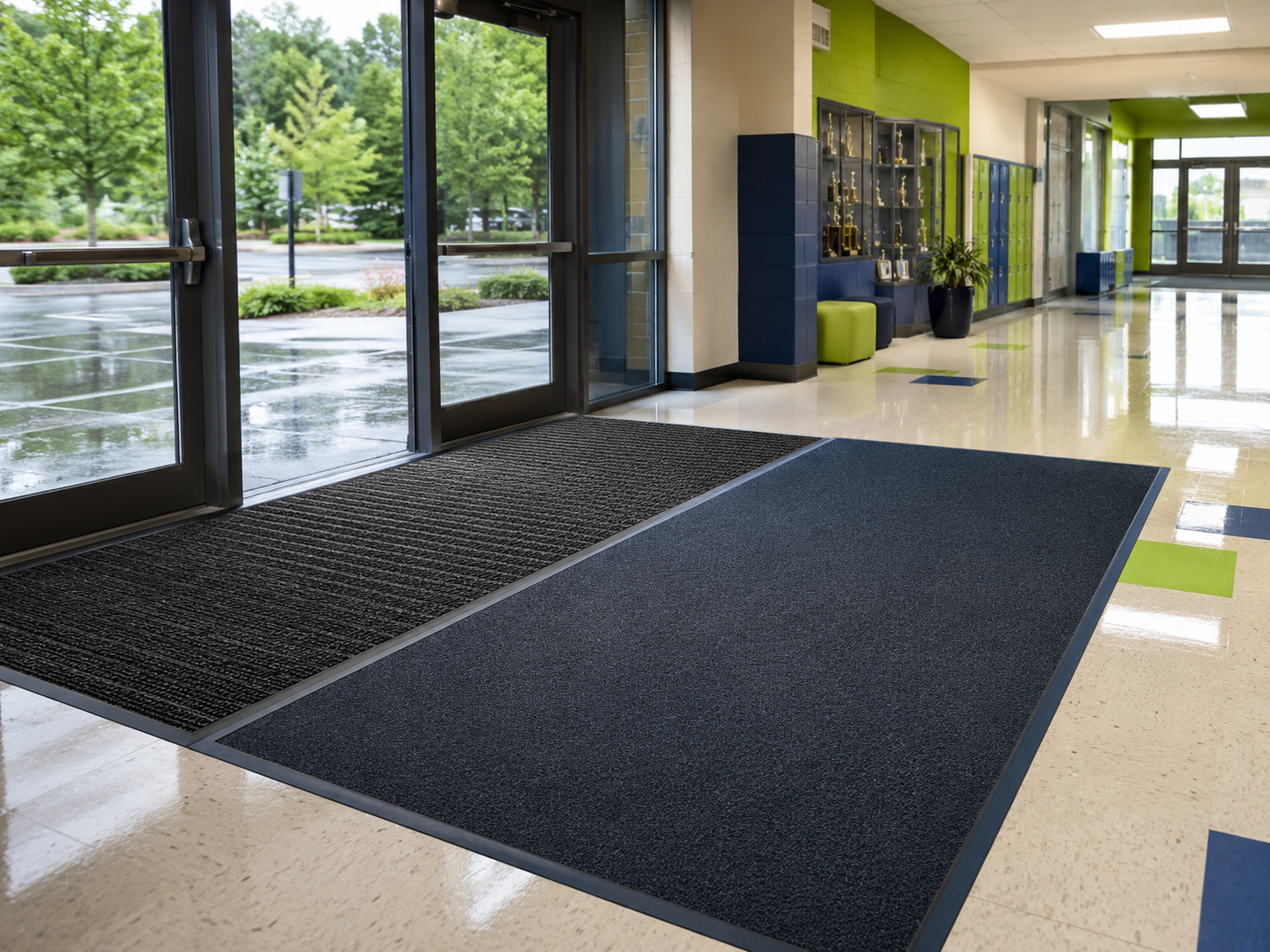
The most effective floor protection strategy starts before visitors reach the floor. A well-designed entrance matting program captures most dirt, moisture, and abrasive grit before they reach your finished floor surface.
Industry guidelines suggest that approximately 80 percent of floor soil enters through entry points. Matting systems that capture the soil at the door dramatically reduce the rate at which the finish wears down and the frequency of deep cleaning and maintenance required throughout the building.
Types of Commercial Entrance Mats
Scraper mats are placed at the exterior entrance to remove heavy soil and debris from shoe soles before entering the building. These handle the first line of defense against tracked-in grit and outdoor contaminants.
Wiper mats are placed in the vestibule or immediately inside the entry to absorb moisture and capture finer particles that the scraper mat missed. A quality wiper mat significantly reduces the amount of dirt that reaches your finished floors.
Combination scraper-wiper mats serve both functions in a single product, which is useful for entry configurations where space limits a two-mat system.
How Much Matting Is Enough
A general guideline for commercial applications is that matting should extend far enough that a visitor takes at least six to eight steps on the mat before reaching the finished floor. This is approximately 10-12 feet of matting at a standard entry point. Most commercial entries are under-matted relative to this standard.
For high-traffic entries during summer rain events, having a plan for additional temporary matting during wet conditions prevents your matting system from becoming overwhelmed and wet, with wet, gritty traffic reaching your floor unchecked.
Maintaining Floor Finish Between Strip Jobs
If your floors were stripped and refinished earlier this summer, the goal now is protecting that investment through the rest of the season. If your floor restoration was done in the spring, summer foot traffic is actively working against the finish you put down.
Routine floor maintenance in summer focuses on two things: keeping the floor clean so abrasive grit is not ground into the finish, and repairing the finish surface before it wears through to the tile.
Daily and Weekly Cleaning
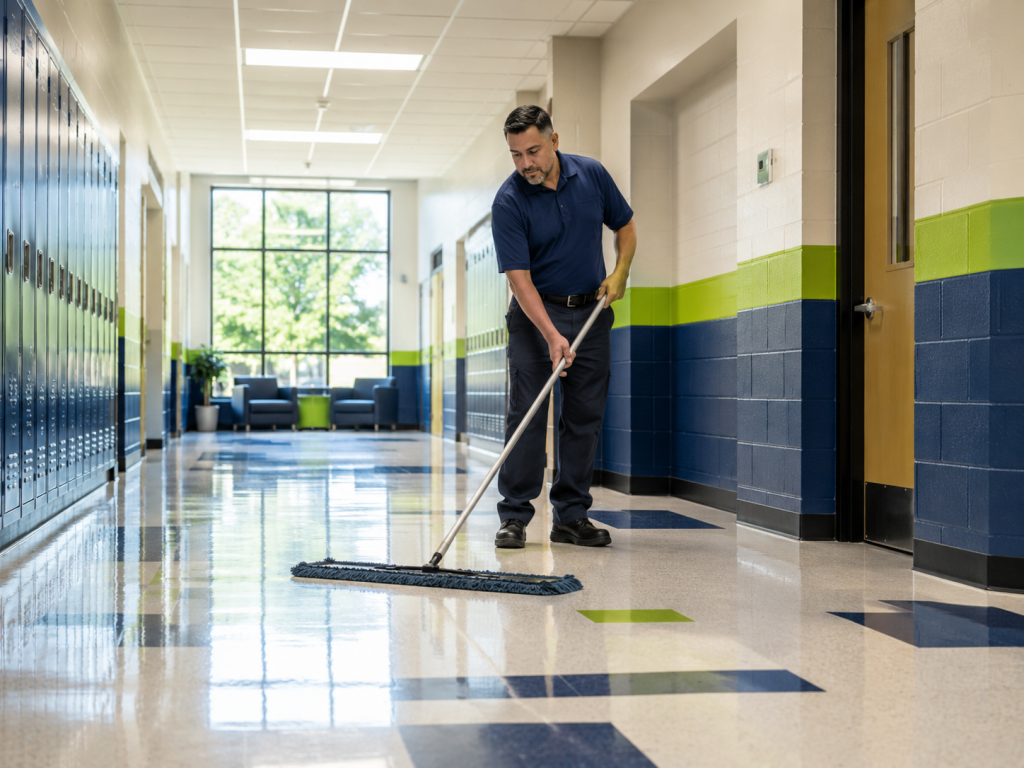
Daily dust mopping removes loose grit from the floor before it can abrade the finish under foot traffic. This single practice has more impact on finish longevity than most other maintenance choices.
Damp mopping with a neutral floor cleaner addresses the soil that dust mopping leaves behind. Use a properly diluted neutral cleaner rather than a general-purpose all-purpose cleaner. Many all-purpose cleaners are too alkaline for regular use on finished floors and will dull the finish over time.
Avoid over-wetting the floor. Excess moisture from mopping stays in seams, grout lines, and under tile edges. In summer humidity, slow-drying floors can contribute to finish adhesion issues during any recoat work.
Spray Buffing for Finish Maintenance
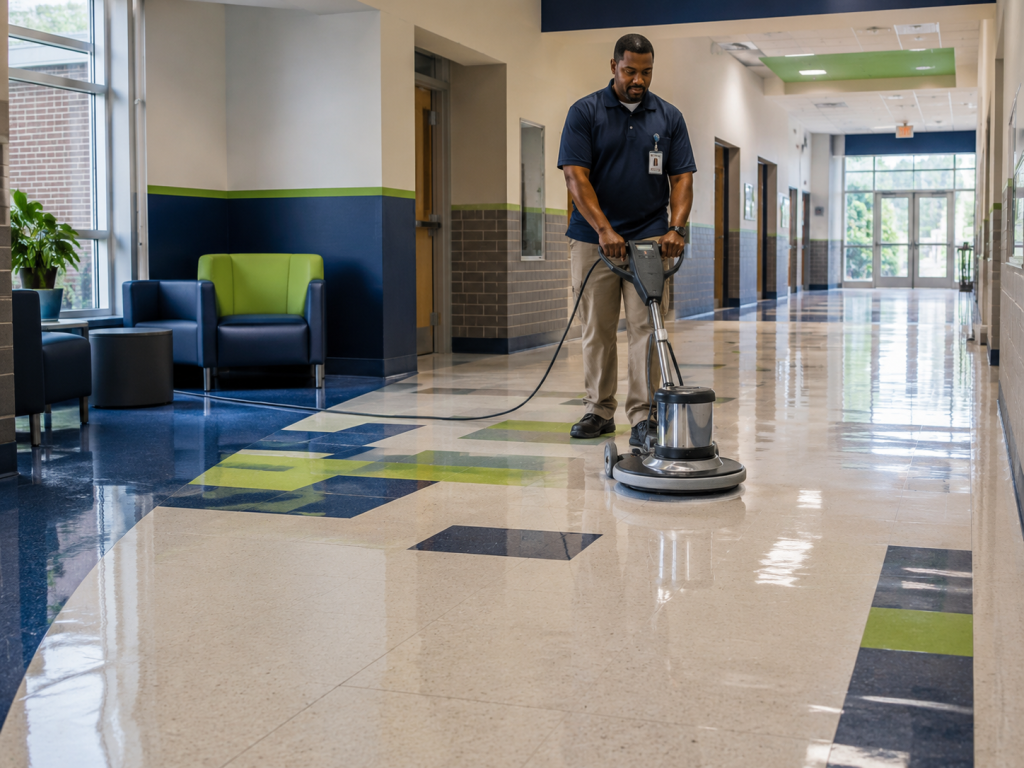
Spray buffing is the intermediate maintenance step between full strip-and-refinish cycles. It uses a high-speed burnisher with a spray buff chemical to restore gloss and lightly resurface the finish layer. Regular spray buffing during the summer months keeps floors looking sharp and delays the need for a more intensive restoration.
For facilities with high-traffic hallways or common areas, a spray buff program on a monthly or quarterly schedule helps maintain appearance. It provides a degree of surface protection between deep floor care cycles.
Recoat When Wear Shows, Not After It Is Too Late
If sections of the floor finish are visibly worn through to the tile, or if the finish has lost gloss and buffing no longer restores it, a recoat is the right move before the situation worsens. Recoating adds new finish coats over the existing surface without a full strip. It is a cost-effective way to extend the life of the finish layer through the end of the season.
The recoat window is before the tile surface is exposed. Once the finish is completely worn through in high-traffic areas, you have less to build on, and the recoat result is less uniform. Catching it early produces a better outcome with less labor.
Choosing the Right Floor Finish for Summer Traffic
Not all floor finish products perform equally under summer conditions. For facilities with heavy summer traffic, a few characteristics matter.
High solids content. A higher solids percentage means more actual protective polymer per coat. A 25-percent solids finish builds more durable protection per coat than a 15-percent solids product. For high-traffic applications, this translates to longer finish life between restorations.
Scuff and black mark resistance. Summer footwear, especially rubber-soled athletic shoes, leaves significant black marks on floor finishes. Finishes formulated for scuff resistance stay looking cleaner between cleanings and maintain appearance better under heavy traffic.
Compatibility with your existing finish. If you are recoating rather than stripping, verify that the new finish is compatible with the existing finish on the floor. Your HJS Supply team can help you confirm compatibility and select the right product for your situation.
Common Mistakes That Cost Facilities in Summer
Skipping dust mopping because the floor looks clean. Fine grit is often invisible to casual inspection but very visible in the scratches it leaves in your floor finish after a day of traffic. Dust mop before every wet cleaning cycle.
Using the wrong cleaner on finished floors. Highly alkaline cleaners gradually strip the floor finish with each application. Over a summer of daily mopping with the wrong product, you can lose most of the finish you put down in the spring. Use a neutral floor cleaner formulated for finished floors.
Under-matting high-traffic entries. A single 3-foot-by-5-foot mat at the front door of a high-traffic facility does not capture enough soil to protect the floor beyond it meaningfully. Invest in adequate matting coverage for your entry points.
Waiting for a full strip to address visible wear. When finish wear is visible but has not reached the tile, a recoat addresses it efficiently. Waiting until the tile is exposed requires more work and produces a less uniform result.
Not increasing cleaning frequency in summer. Higher traffic and more tracked-in soil in summer mean the cleaning schedule that worked in spring may not be keeping up. Adjust the frequency of dust and damp mopping to match the actual soil load.
Frequently Asked Questions About Commercial Floor Care in Summer
How does summer foot traffic damage commercial floor finish? Fine dirt, grit, and sand tracked in from outdoor surfaces are abrasive. Under foot traffic, they act like sandpaper against the finish, dulling the gloss and wearing through the finish layer. Moisture from rain and wet shoes temporarily softens the finish, making it more vulnerable to damage. Regular dust mopping removes abrasive grit before it can cause this wear.
How much entrance matting does a commercial building need? Industry guidelines recommend approximately 10 to 12 feet of matting at primary entry points so that visitors take enough steps on the mat to remove most of the soil from their shoes before reaching finished floors. Most commercial entries benefit from a scraper mat at the exterior entrance and a wiper mat inside the vestibule.
What is the difference between spray buffing and recoating? Spray buffing uses a high-speed machine and a spray-buff chemical to restore gloss to an existing finish. It is a maintenance step that keeps floors looking sharp between restoration cycles. Recoating applies new finish coats over the existing surface to rebuild the protective layer where it has worn thin. Both are intermediate steps between full strip-and-refinish jobs.
Can I recoat floors without stripping them first? Yes, in most cases. Recoating is appropriate when the existing finish is in reasonable condition but needs to be built up in worn areas. The floor must be thoroughly cleaned and the existing finish lightly abraded or chemically prepared to ensure adhesion of the new coat. If the finish is contaminated, peeling, or has extensive damage, a full strip may be necessary first.
Does HJS Supply carry floor care products for summer maintenance? Yes. HJS Supply Co. carries commercial floor finishes, neutral floor cleaners, spray-buff products, and entrance matting suited for summer floor maintenance programs. Our team can help you select the right products for your floor type and traffic level.
Protect Your Floors Through the Rest of Summer
The floors you restored this spring can hold up through the season and into fall if the right maintenance program is in place. That means adequate matting at your entries, consistent dust mopping to remove abrasive grit, the right cleaner for daily maintenance, and a recoat when wear starts to show.
HJS Supply Co. has the floor care chemicals, finish products, and entrance matting your facility needs to stay ahead of summer wear. Stop in at 2983 Seneca Street in West Seneca, call us at (716) 674-9860, or browse our full product lineup at hjssupply.com. Our team works with facilities and building service contractors throughout Western New York and can help you build a floor protection program that keeps your floors looking the way they should all season long.