
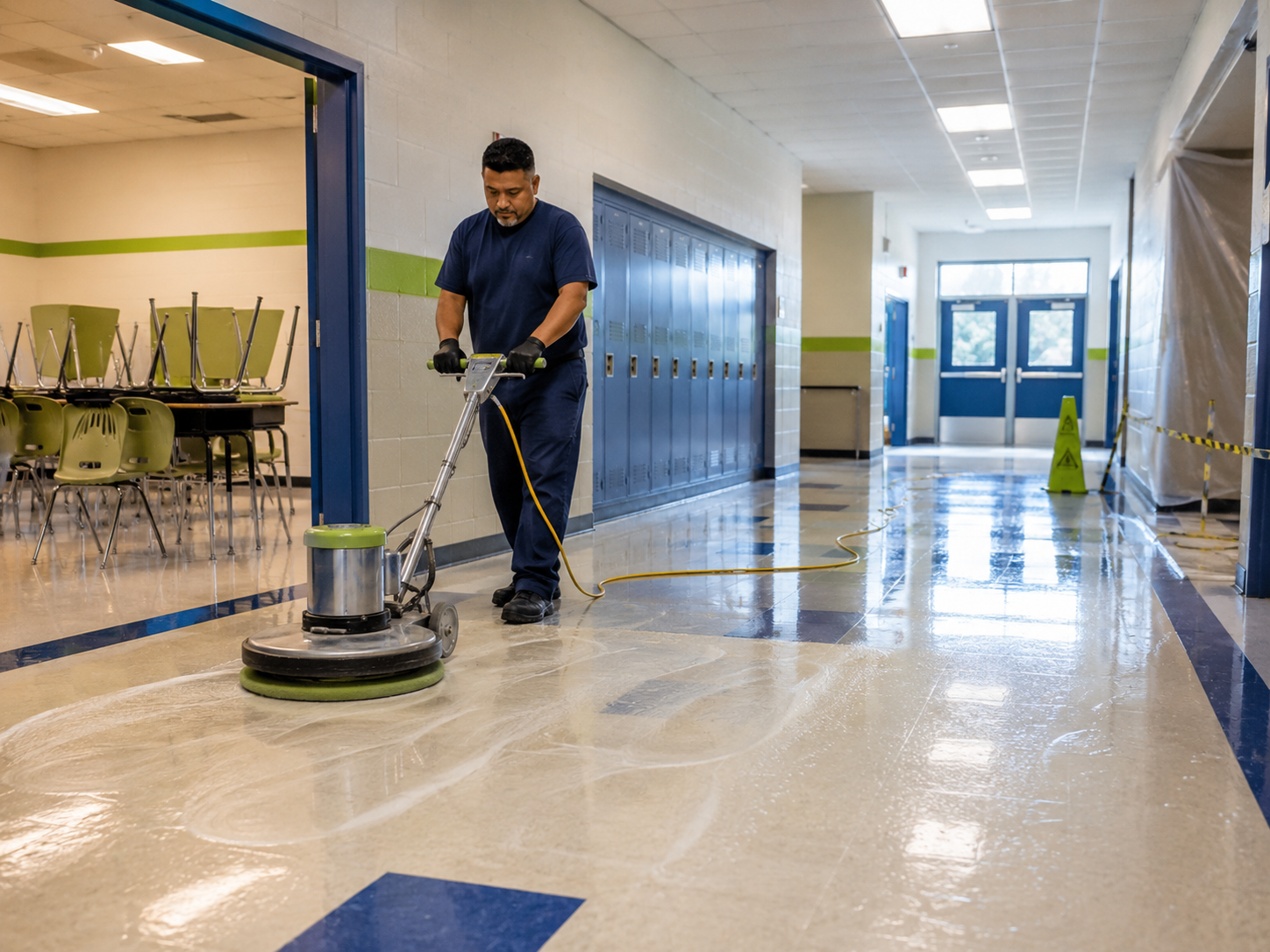
If you manage custodial operations for a school or educational facility, you already know what July means: the clock is running.
The stretch between the last day of school and the first day back is the only time you have to strip, refinish, and restore floors without working around students, staff, and daily traffic. Hallways, cafeterias, gymnasiums, and classrooms have absorbed a full school year of foot traffic, scuff marks, and finish wear. Back-to-school floor stripping and waxing is not just cosmetic maintenance. It protects your flooring investment, reduces long-term wear, and sets the standard for how your facility looks for the entire year ahead.
Getting it done right comes down to using the right products, following the right process, and moving efficiently through a tight schedule. Here is what that looks like.
Why Summer Is the Only Real Window for Floor Restoration
Stripping and refinishing floors in an occupied school is not practical. Strip solution needs dwell time. The finish needs to dry and cure between coats. And the fumes and wet floors that come with the process are not compatible with active hallways and classrooms.
Summer gives you empty buildings, controlled traffic, and the ability to work through spaces in a logical sequence without interruption. For facilities with vinyl composition tile (VCT) in hallways, common areas, and classrooms, this is the time to restore the floor to a condition that will hold up through another full year of use.
July is the right time to start, not the end of August. Rushing a floor restoration produces poor results. Finish that has not fully cured scuffs and marks immediately. Coats applied too quickly do not bond properly. Starting in July gives you the buffer you need to do the job correctly and handle any surprises.
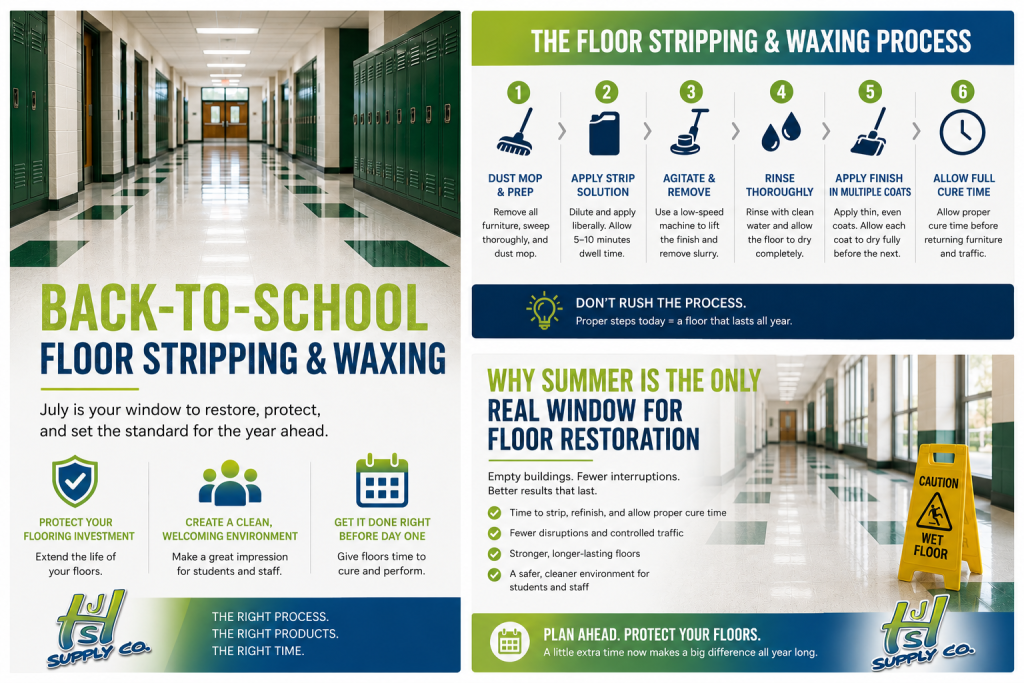
The Floor Stripping and Waxing Process, Step by Step
Back-to-school floor restoration is a defined process. Cutting corners on any step creates problems that compound throughout the year.
Step 1: Dust Mop and Prep the Area
Before any chemicals are applied, remove all furniture, sweep thoroughly, and dust mop to clear loose debris. Stripping solution works on the finish, not on dirt and grit sitting on top of it. Starting clean gives the chemical direct contact with the surface it needs to break down.
Step 2: Apply Strip Solution
Dilute your floor stripper according to the product label for the soil level and number of finish coats you are removing. Apply liberally with a mop, working in manageable sections. Do not let the solution dry on the floor.
Allow the stripper to dwell for the recommended time, typically 5 to 10 minutes, so it can penetrate and soften the finish layers. For heavily built-up floors with multiple old finish coats, a longer dwell time and a stronger dilution may be necessary.
Step 3: Agitate and Remove
Use a low-speed floor machine with a stripping pad to agitate the solution and lift the finish from the floor. Work in overlapping passes to ensure full coverage. A wet vacuum or mop and bucket removes the slurry as you go. Do not let the solution dry back down onto the floor.
Step 4: Rinse Thoroughly
This step is often rushed, and it should not be. Strip solution residue left on the floor will interfere with finish adhesion and cause your new coats to look hazy, fish-eye, or peel prematurely. Rinse with clean water, change your rinse water frequently, and allow the floor to dry completely before applying the finish.
For large facilities, a neutralizing rinse can help ensure the floor surface pH is balanced before finishing.
Step 5: Apply Floor Finish in Multiple Coats
Apply floor finish in thin, even coats using a clean finish mop or applicator. Allow each coat to dry fully before applying the next. Rushing between coats is the most common mistake in school floor restoration.
For high-traffic school hallways and cafeterias, three to five coats of a quality commercial floor finish are standard. More coats build a thicker finish layer that holds up better to foot traffic and cleaning.
Step 6: Allow Full Cure Time Before Traffic
Floor finish reaches its final hardness and durability through curing, not just drying. Allow adequate cure time before moving furniture back and resuming foot traffic. Heavy traffic on the under-cured finish causes scratches and scuffs that are visible from day one of the school year.
Choosing the Right Products for School Floors
Not all floor care products are equal, and the school environment has specific requirements.
Floor Stripper: For VCT in school environments, a non-butyl, low-odor stripper is worth consideration. Occupied or semi-occupied facilities benefit from formulas that minimize fume exposure, and many school districts have chemical use policies that favor low-VOC options.
Floor Finish: School hallways need a finish with high durability and good scuff resistance. A higher solids content finish builds a tougher wear layer per coat. Look for products rated for high-traffic commercial applications rather than general-purpose finishes.
Applicator Pads and Mops: Using the right stripping pad hardness for your floor machine and a clean, dedicated finish mop for each product makes a significant difference in results. Cross-contaminating your finish mop with stripper residue will ruin a coat.
HJS Supply carries floor-care chemicals and equipment suited for school and institutional floor-restoration programs. Our team can help you select the right stripper and finish for your floor type, soil level, and traffic conditions.
Common Mistakes That Hurt School Floor Results
Starting too late. Beginning the strip-and-refinish process in late August leaves no margin for error. Rushed drying, rushed curing, and rushed application result in a floor that looks worn within weeks.
Skipping the rinse. Stripper residue beneath the new finish is a leading cause of premature finish failure. The rinse step is not optional.
Applying the finish too thick. Thick coats take longer to dry and do not bond as well as thin, even coats. More thin coats produce a better result than fewer heavy ones.
Not changing stripping pads. A worn or loaded stripping pad loses cutting ability and leaves behind residue. Change pads regularly during the job.
Neglecting transition areas and room edges. Hallways get the most attention, but classrooms, cafeteria perimeters, and stairwells deserve the same process. Inconsistent treatment shows up quickly.
Frequently Asked Questions About Back-to-School Floor Stripping and Waxing
How often should school floors be stripped and refinished? Most school VCT floors are fully stripped and refinished once per year during the summer. Facilities with very high traffic may require a mid-year strip and recoat, while lower-traffic areas can sometimes go two years between full restorations. Regular spray buffing and interim maintenance extend the life of the finish between full strip jobs.
How many coats of floor finish should a school hallway get? Three to five coats is a common range for high-traffic school hallways. The goal is to build a finish layer thick enough to absorb a full year of wear without exposing the tile. The number of coats also depends on the solids content of the finish you are using.
Can school floors be stripped and waxed while the building is occupied? It is not recommended for full strip-and-refinish work. The process involves chemicals, wet floors, and a cure time that are not compatible with occupied spaces. Limited touch-up work or spray buffing can sometimes be done in off-hours, but a full restoration should be done during a break period.
What type of floor finish works best for schools? A commercial-grade, high-solids floor finish rated for heavy traffic performs best in school environments. Products with good scuff and black mark resistance are especially useful in hallways where rubber-soled shoes are constant. Ask the HJS Supply team for a recommendation based on your specific floor conditions.
Does HJS Supply carry floor care products for school facilities? Yes. HJS Supply Co. carries commercial floor strippers, finishes, applicators, and equipment suited for institutional floor restoration programs. Contact our team for product recommendations and current availability.
Start Your Back-to-School Floor Program Now
The summer floor restoration window closes faster than it feels like it will. Schools that plan their strip-and-refinish schedule in July finish with properly cured, durable floors, ready for the first day back. Schools that wait until the last two weeks often open the year with floors that already look like they need help.
HJS Supply Co. has the floor-care chemicals, finishing products, and equipment your custodial team needs to do the job right. Visit us at 2983 Seneca Street in West Seneca, call us at (716) 674-9860, or browse our product lineup at hjssupply.com. Our team works with school districts and building service contractors throughout Western New York, and we can help you plan a floor restoration program that fits your timeline and your facility.